
The Advent of the Avatar: The Birth of Lord Krishna
Lord Krishna was born in the “Rohini” Nakshatra which is considered to be very auspicious as it is supervised by […]
Lord Krishna was born in the “Rohini” Nakshatra which is considered to be very auspicious as it is supervised by Lord Brahma
The birth of Krishna is not merely a mythological tale; it is considered a turning point in cosmic history, marking the transition from the Dwapara Yuga to the Kali Yuga.
1. The Divine Mythology: The Story of the Midnight Birth
The narrative of Krishna’s birth is a saga of divine intervention against human tyranny.
-
The Prophecy: During the wedding of Princess Devaki to Vasudeva, a celestial voice (Akashvani) warned the tyrant King Kansa that the couple’s eighth child would be his slayer.
-
The Prison Years: Kansa imprisoned his sister and her husband, killing their first six children. The seventh, Balarama, was mystically transferred to Rohini’s womb.
-
The Appearance: On the eighth day (Ashtami) of the dark fortnight of Bhadrapada, at midnight, Lord Krishna appeared in the prison cell in his four-armed Vishnu form before transforming into a human infant.
-
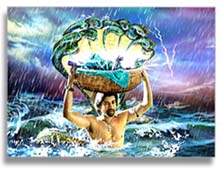
The Miraculous Crossing: As Vasudeva carried the baby to safety, the prison guards fell into a deep sleep, and the locks shattered. The Yamuna River, raging with monsoon floods, parted to make way, while the serpent Sheshnaga shielded the infant from the storm.
-
The Exchange: Krishna was taken to the house of Nanda and Yashoda in Gokul, ensuring the “Protector of the Universe” was raised in the humble surroundings of a cowherd community.
2. Historical Context: The Chronology of Krishna
While often viewed as a legend, ancient Indian texts provide a specific timeline for Krishna’s life.
-
Puranic Timeline: According to the Vishnu Purana and Bhagavata Purana, Krishna’s departure from the earth marked the beginning of the Kali Yuga.
-
Astronomical Dating: Using planetary positions described in the Mahabharata (such as the solar eclipse during the Kurukshetra war), many scholars and archaeo-astronomers date Krishna’s birth to approximately July 18, 3228 BCE.
-
The Era of Janapadas: Krishna’s life is set during the late Vedic period, a time of transition between nomadic tribes and the established kingdoms (Mahajanapadas) of northern India.
3. Proofs of Presence: Archaeological & Scriptural Evidence
Modern science and ancient literature offer compelling evidence regarding the historical reality of Krishna.
-
The Sunken City of Dwarka: Marine archaeologists led by Dr. S.R. Rao discovered a submerged city off the coast of Gujarat. The ruins—including fortified walls, stone anchors, and pottery—match the descriptions of Krishna’s capital, Dwarka, which was said to have been swallowed by the sea.
-
Epigraphic Evidence: The Heliodorus Pillar (113 BCE) in Vidisha, Madhya Pradesh, contains an inscription by a Greek ambassador describing himself as a “Bhagavata” (devotee of Krishna/Vasudeva), proving that Krishna worship was established long before the modern era.
-
Ancient Coins: Indo-Greek coins dating back to the 2nd century BCE (Agathocles of Bactria) depict figures carrying a Chakra (discus) and a Hala (plow), identified as Krishna and Balarama.
-
Literary References: Krishna is mentioned in the Chandogya Upanishad (dated approx. 8th–6th century BCE) as “Krishna Devakiputra,” a student of Ghora Angirasa.
4. Spiritual Significance: Why the Avatar Descended
The purpose of Krishna’s birth is summarized in the Bhagavad Gita (Chapter 4, Verse 7-8):
-
Dharma Sansthapana: To re-establish the principles of righteousness when the world is overwhelmed by ego and cruelty.
-
Protection of the Virtuous: To provide solace to devotees like Devaki, Vasudeva, and the sages who suffered under Kansa’s rule.
-
The Lesson of Detachment: Unlike other avatars, Krishna’s life (from his “stolen” childhood to his role as a charioteer) teaches that the Divine is accessible through love, playfulness, and duty without attachment.
5. The Legacy of the Birthplace (Janmabhoomi)
The site of Krishna’s birth in Mathura, known as the Shri Krishna Janmabhoomi, remains one of the holiest places on earth.
-
The Garbha Griha: The exact spot of the prison cell is preserved within the temple complex, where millions gather annually on Janmashtami to witness the “birth” ceremony at midnight.
-
The Eternal Connection: The birth of Krishna serves as a bridge between the human and the divine, proving that God can manifest in the darkest of places (a prison) to bring light to the world.
6. The Celestial Timing: The Science of the “Ashtami Tithi”
The birth of Krishna is not a fixed calendar date but a precise alignment of time and stars, which is why it changes every year.
-
The Tithi: Krishna was born on the Ashtami (8th day) of the Krishna Paksha (dark fortnight). This symbolizes that the Divine appears even when the moon (and the world) is at its darkest.
-
Rohini Nakshatra: Mythologically, Krishna was born under the Rohini Nakshatra. This star is associated with growth, beauty, and sensuality, explaining Krishna’s magnetic and charming persona.
-
The Midnight Muhurta (Nishita Kaal): The “Birth” is only celebrated during the Nishita Kaal, the specific 48-minute window at midnight. This is considered the most powerful time for spiritual manifestation.
-
The Solar-Lunar Balance: Janmashtami always falls during the monsoon (Bhadrapada), representing the life-giving nature of rain and the washing away of sins.
7. Symbols of the Advent: Iconography & Meaning
To finish the “Ultimate” guide, we must define the symbols associated with his birth:
-
The Flute (Bansuri): Represents the human heart. Just as the flute is hollow, we must empty ourselves of ego so the Divine can play his melody through us.
-
The Peacock Feather (Mor-Pankh): Symbolizes the entire spectrum of nature and the “thousand eyes” of the universe watching over the devotee.
-
The Butter Pot (Maakhan): Symbolizes the “essence” of the soul. Just as butter is extracted from milk through churning, wisdom is extracted from life through experiences.
“Whenever there is a decline in Dharma… I manifest myself.” — Lord Krishna