
Maharana Pratap Jayanti
The birth anniversary of the courageous ruler of Mewar, Maharana Pratap, falls on May. Explore more about Maharana Pratap Jayanti. […]
The birth anniversary of the courageous ruler of Mewar, Maharana Pratap, falls on May. Explore more about Maharana Pratap Jayanti.
Maharana Pratap Jayanti: A Comprehensive Guide to the Lion of Mewar
Maharana Pratap Jayanti celebrates the birth of the legendary Mewari King, Maharana Pratap Singh I. Beyond a mere historical figure, Pratap is a cultural phenomenon representing the “Eternal Flame of Liberty.” This guide explores the depths of his life, his divine associations, and the landmarks that stand as silent witnesses to his bravery.
1. Historical Context: The Unbroken Lineage
Maharana Pratap was born in an era when the Mughal Empire, under Akbar the Great, was consolidating power across the Indian subcontinent. While many Rajput states formed alliances with the Mughals for political security, the House of Mewar stood its ground.
-
Date of Birth: May 9, 1540 (officially celebrated on the 3rd day of the Jyestha Shukla phase).
-
The Struggle for Chittor: Pratap’s father, Udai Singh II, founded Udaipur after the fall of Chittor. Pratap spent his life not just trying to regain a fort, but protecting the cultural identity of his people.
2. Mythology and Divine Influence
The narrative of Maharana Pratap is deeply intertwined with Hindu mythology and spiritual symbolism:
-
Suryavanshi Roots: The Mewar dynasty claims direct descent from Lord Rama. This “Solar Lineage” instilled a sense of “Dharma” (Duty) in Pratap, making his resistance a spiritual crusade rather than just a territorial war.
-
The Eklingji Connection: The Maharanas of Mewar consider themselves not as kings, but as the Diwans (Prime Ministers) of Lord Eklingji (an avatar of Shiva). This belief meant that Pratap felt he was defending the territory of God Himself, making surrender an impossibility.
-
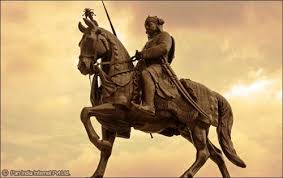
The Folklore of the Blue Horse: In Rajasthani ballads (Rasos), Chetak is described as a divine entity—a horse with a spirit so pure it could sense its master’s thoughts. This mythological bond highlights the Rajput ideal of loyalty between man and nature.
3. Military Strategy: The Father of Guerrilla Warfare
Long before the term was popularized, Maharana Pratap mastered Guerrilla Warfare (Chapaamaar Yuddha).
-
Topographical Advantage: He turned the jagged Aravalli hills into a fortress. His knowledge of hidden mountain passes allowed him to strike large Mughal convoys and disappear before they could retaliate.
-
The Inclusive Army: Pratap broke social barriers by recruiting the Bhil Adivasis. These forest dwellers provided the intelligence and archery skills that the traditional heavy cavalry lacked, creating a formidable “People’s Army.”
4. Iconic Landmarks: The Pillars of Mewar
For travelers and history buffs, these sites are essential to understanding the Pratap era:
-
The Great Wall of Kumbhalgarh: Protecting the birthplace of Pratap, this wall is 36km long. It is said that Pratap’s mother, Queen Jaiwanta Bai, personally oversaw his training within these indestructible walls.
-
The Haldighati Pass: The narrow pass where the soil remains yellow to this day. There is a local myth that the soil turned yellow from the turmeric-colored robes of the Rajput warriors who swore to fight to the death.
-
Rakta Talai: Meaning the “Lake of Blood,” this is a spot near Haldighati where the carnage was so intense that a lake of blood was formed. Today, it is a serene memorial garden.
-
Chawand: The final capital built by Pratap. Here, he spent his last years patronizing Mewari Art and Literature, proving he was as much a man of culture as he was a man of war.
5. Significance in Modern India
Why does a 16th-century king matter in 2026?
-
A Symbol of Self-Reliance: His life is the ultimate example of Atmanirbharta (Self-Reliance). He survived on grass bread (Ghaas ki Roti) rather than feast under the shadow of a foreign ruler.
-
Educational Value: He is a staple in Indian textbooks, serving as the primary role model for secularism and unity, as his top commander at Haldighati was a Muslim Pathan, Hakim Khan Suri.
इस आर्टिकल को हिंदी में पढ़ने के लिए यहां क्लिक करें