
Payippad Boat Race
Payippad Boat Race is between September and is held on the Payippad River near Haripad in Kerala snake boats are […]
Payippad Boat Race is between September and is held on the Payippad River near Haripad in Kerala snake boats are the highlight of this race.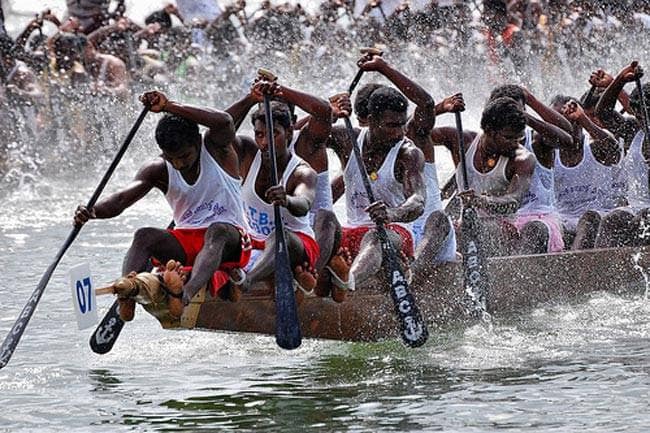
The Payippad Boat Race (also known as the Payippad Vallam Kali) is one of the oldest and most prestigious snake boat races in Kerala. Unlike many other races that are primarily competitive, the Payippad race is deeply rooted in a 300-year-old temple legend.
Held on the pristine waters of the Payippad River in Alappuzha, this event is a spectacular display of synchronized rowing, rhythmic songs (Vanchippattu), and intense communal harmony.
1. Significance and Legend: The “Prathista” Story
The Payippad Boat Race is unique because it celebrates a specific religious event: the installation (Prathista) of the idol of Lord Subramanya (Swamy Ayyappa’s brother) at the Haripad Sree Subrahmanya Swamy Temple.
-
The Vision: Centuries ago, the villagers of Haripad had a vision that an idol of Lord Subramanya was lying at the bottom of the Kayamkulam Lake.
-
The Discovery: The villagers set out in their boats and found the idol exactly where the vision had predicted.
-
The Procession: The idol was brought back to Haripad in a grand procession of boats. The modern-day Payippad Boat Race is a three-day reenactment of that joyous return journey.
2. Schedule and Timing for 2026
The race takes place during the Onam festival season. It specifically falls on the Chathurthi (4th day) after Thiruvonam.
3. The “Chundan Vallams” (Snake Boats)
The stars of the race are the Chundan Vallams. These are engineering marvels of ancient Kerala:
-
Dimensions: These boats are over 100 feet long and can hold up to 100 to 110 rowers.
-
Crew Structure: Each boat has about 90-100 oarsmen, 5-10 people to sing the rhythmic songs, and a few “Amarakkars” (helmsmen) at the back to steer the massive vessel.
-
The Sound: The rowers move in perfect synchronization to the beat of drums and the Vanchippattu (boat songs), which tell stories of the deity and Kerala’s history.
4. Key Highlights of the Event
-
Water Procession: Before the competitive racing begins, there is a ceremonial water procession. Rows of decorated boats, traditional umbrellas (Muthukkuda), and artists performing folk arts glide down the river.
-
Intense Competition: Despite its religious roots, the race is fiercely competitive. Different villages (Karas) spend months training their rowers to win the coveted trophy.
-
Massive Attendance: Approximately 25,000 to 40,000 spectators line the banks of the Payippad River to witness the event, making it one of the largest gatherings in the Alappuzha district during Onam.
5. Statistics and Technical Details
-
Age of Tradition: Over 300 years old.
-
Number of Boats: Typically, 15 to 20 Chundan Vallams (Snake Boats) and several smaller categories (Veppu and Odi vallams) participate.
-
Distance: The racecourse is approximately 1.5 to 2 kilometers long.
6. Travel and Visitor Information
-
Location: Payippad River, Haripad, Alappuzha District, Kerala.
-
How to Reach:
-
By Air: The nearest airport is Cochin International Airport (COK), about 115 km away.
-
By Rail: Haripad has its own railway station (HAD) which is well-connected to major cities like Kochi and Trivandrum.
-
By Road: Haripad is situated on the National Highway 66 (NH 66).
-
-
Pro-Tip: Arrive by 11:00 AM to get a good spot on the banks, as the main races usually reach their peak in the afternoon (2:00 PM – 5:00 PM).
Since the Payippad Boat Race is a localized, high-energy event in a rural setting (Haripad), there aren’t many “official” ticketed galleries like you would find at the Nehru Trophy. However, for the 2026 Grand Finale on August 30, here are the best viewing spots and “galleries” you should know about:
1. The Finishing Point Pavilion (Main Gallery)
The most coveted spot is the Haripad Boat Race Committee Pavilion located at the finishing point on the banks of the Payippad River.
-
Why here: This is where the winners are decided and where the heat of the competition is most intense. You get to see the final “surge” of the oarsmen.
-
Accessibility: Usually requires an invitation or a nominal entry fee/pass issued by the local temple committee or the boat race club.
2. Temporary “Kizhakke” (Eastern) Bank Galleries
A week before the race, local residents and the committee build temporary wooden and bamboo galleries along the eastern banks.
-
The Experience: These are the most “humanized” and authentic spots. You’ll be sitting with thousands of local fans who cheer for their village boats.
-
Cost: Usually free or a very small “seat fee” (approx. 50–100 INR) charged by the landowner whose backyard faces the river.
3. Private House Balconies and Rooftops
The Payippad River is lined with traditional Kerala houses.
-
Pro-Tip: Many locals turn their rooftops and balconies into private “VIP Galleries.” If you are a tourist, locals are often incredibly hospitable—sometimes a friendly conversation can land you a seat on a private balcony with a perfect aerial view of the river.
4. Bridge View (Haripad-Veeyapuram Road)
There is a bridge over the Payippad River that offers a “top-down” view of the start of the race.
-
Why here: You can see the perfect synchronization of the 100 rowers from above.
-
Constraint: This area gets extremely crowded early in the morning and is often restricted by local police for safety reasons during the actual race.
5. Mobile Galleries (Country Boats)
For a truly “ultimate” experience, you can hire a small country boat (Vallom) and anchor it at a safe distance from the race track.
-
Warning: You must stay behind the police patrol boats. Being on the water while the “Snake Boats” thunder past you is an experience unlike any other, as you can feel the vibration of the water.
Tips for 2026 Visitors:
-
Arrive Early: By 11:30 AM, most prime spots are taken. The heats start around 1:00 PM and the final is usually around 4:30 PM.
-
Weather Prep: August in Kerala is monsoon season. Bring a sturdy umbrella or a rain poncho; the race never stops for rain—in fact, the rain makes it more exciting!
-
Photography: If you want the “Ultimate” shot of the rowers’ faces, try to secure a spot about 100 meters before the finishing line on the Western bank.