
The Divine Symphony: Krishna Janmashtami Bhajans
Janmashtami remains incomplete without the bhajans devoted to Lord Krishna, the Bhajans are based on stories, events and deeds of […]
Janmashtami remains incomplete without the bhajans devoted to Lord Krishna, the Bhajans are based on stories, events and deeds of Lord Shri Krishna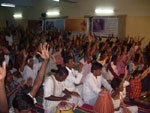
In the spiritual tradition of India, a Bhajan is more than just a song; it is an act of “Bhaavyam” (becoming one with the sacred). On Janmashtami, as the world awaits the birth of Lord Krishna at midnight, these musical prayers serve as a bridge between the devotee and the Divine.
1. The Significance of Bhajans
-
Definition: The word “Bhajan” is rooted in the Sanskrit “Bhaj,” meaning to share, to belong, or to worship. The syllable “Ja” refers to Japa (repetition of the Name). Thus, Bhajans are the musical form of meditation.
-
The Power of Vibration: Krishna is often called Nada-Brahman (Sound Personified). It is believed that singing his glories purifies the environment and creates a “Sattvik” (pure) vibration that makes the heart a fit place for the Lord to be born.
-
Emotional Connection: Unlike complex Vedic mantras, Bhajans are written in simple languages (Hindi, Braj, Sanskrit) to allow the common person to express Bhakti (love) through various moods—whether it is the motherly love of Yashoda or the longing of the Gopis.
2. How Krishna Bhajans Begin
A traditional Bhajan session on Janmashtami follows a specific spiritual structure:
-
Ganesh Vandana: Invoking Lord Ganesha to remove obstacles.
-
Guru Vandana: Paying respect to the teacher who leads one to God.
-
The Sankirtan: Starting with a slow, meditative chant like “Hare Krishna” or “Radhe Radhe.”
-
The Crescendo: As midnight approaches, the tempo increases, symbolizing the rising excitement and joy of Krishna’s arrival.
3. Featured Janmashtami Bhajans (with Lyrics)
I. Shyam Chudi Bechne Aaya (The Divine Trickster)
This Bhajan celebrates the ‘Leela’ where Krishna disguises himself as a bangle-seller to meet Radha.
Mukhda: Manihari ka bhesh banaya, Shyam chudi bechne aaya Chhaliya ka bhesh banaya, Shyam chudi bechne aaya Galiyon mein shor machaya, Shyam chudi bechne aaya
Antara: Radha ne suni Lalita se kahi, Mohan ko turant bulaya Chudi laal nahi pehnu, Chudi hari nahi pehnu Mujhe Shyam rang hai bhaaya, Shyam chudi bechne aaya
Radha pehnan lagi, Shyam pehnane lage Radha ne haath badaya, Shyam chudi bechne aaya Radha kehne lagi, Tum toh chhaliya Bade dheere se haath dabaya, Shyam chudi bechne aaya.
II. Bhajo Radhe Govinda (The Protector of Devotees)
A powerful chant that highlights Krishna’s role as the savior of his bhaktas.
Mukhda: Bhajo Radhe Govinda, Gopala Tera pyara naam hai Nandalala Tera pyara naam hai
Antara: Mor mukat maathe tilak viraje, Gale vaijanthimala Koi kahe Vasudev ka Nandan, Koi kahe Nandalala
Gaj aur Grehe lade jal bitar, Jal mein chakra chalaya Jab jab bhid padi bhagaton par, Nanggi pairin dhaya Bhajo Radhe Govinda!
III. Mere Pyare Madan Gopal (Ode to the Infant Lord)
Focuses on the beauty and ‘Shringar’ of the baby Krishna (Laddu Gopal).
Choti choti gaiyan, chote chote gawaal, Chote se mere, Madan Gopal Mor mukut mathe saaje, gale mein swaranmaal, Kaano mein karanphool, haathon mein ratnajadhit hath haar, Pitamber saaje tan pe, uspe sundar motiyon ki maal Pairon mein jhanjhar sohe, jab nache hari angana dwaar. Bhaye sab ke mann ko bal gopal, karke solah shringar!
IV. Darshan Do Ghanshyam (The Prayer for Vision)
A classic plea for a glimpse of the Divine, often sung in deep meditation.
Darashan do ghanashyam naath mori, Ankhiyan pyaasi re Man mandir ki jyoti jagaado, Ghat ghat basi re Naam jape par tujhe naa jaane, Unako bhi tu apanaa maane Teri dayaa kaa ant nahin hai, He dukh nashi re Laj naa lut jaaye prabhu teri, Naath karo naa dayaa mein deri!
4. Why Bhajans are Popular and Helpful
-
Mental Peace: In a chaotic world, the rhythmic chanting (Kirtan) reduces cortisol levels and induces a state of calm.
-
Accessibility: You don’t need to be a scholar to sing a Bhajan. It is the “Direct Path” (Marga) to God through emotion rather than ritual.
-
Unity: On Janmashtami, thousands of people sing together in temples, breaking all barriers of caste and wealth through a shared melody.
-
Spiritual Awakening: Consistent listening to Krishna Bhajans is said to awaken the “Krishna Consciousness”—a state of constant awareness of the divine presence.
5. The “Nishita Kaal” Finale
As 12:00 AM approaches, the Bhajans reach their peak. The singing stops for a moment of silence for the Abhishek, followed by the roaring chant of:
“Hathi Ghoda Palki, Jai Kanhaiya Lal Ki!”
This marks the transition from the Bhajan of longing to the Aarti of celebration.
श्रीकृष्ण भजन हिंदी में पढ़ें और सुनें, क्लिक करें