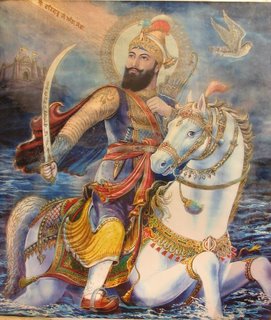
Guru Gobind Singh Ji (1666–1708) was the tenth and final human Sikh Guru. A true "Warrior-Saint," he was a gifted poet, a profound philosopher, and a fearless military commander. His most significant legacy was the founding of the Khalsa Panth in 1699, which fundamentally reshaped the identity of the Sikh community into a brotherhood of saint-soldiers dedicated to justice and equality.
Quick Reference: Life of Guru Gobind Singh Ji
| Feature | Details |
| Birth Name | Gobind Rai |
| Date of Birth | December 22, 1666 (Prakash Utsav) |
| Birthplace | Patna, Bihar (Takht Sri Patna Sahib) |
| Parents | Guru Tegh Bahadur Ji and Mata Gujri Ji |
| Succession | Became Guru at age 9 after his father's martyrdom |
| Major Creation | The Khalsa Panth (1699) |
| Eternal Successor | Guru Granth Sahib (The Holy Scripture) |
The Transformation: Founding of the Khalsa
The most defining moment in Sikh history occurred on Baisakhi in 1699 at Anandpur Sahib. Guru Gobind Singh Ji called for a gathering where he requested five volunteers willing to sacrifice their lives for righteousness. These five became the Panj Pyare (the Five Beloved Ones), the first members of the Khalsa.
The Five K’s (Kakkars):
He commanded every Khalsa Sikh to wear five symbols of faith at all times:
-
Kesh: Uncut hair (symbolizing spirituality).
-
Kara: An iron bracelet (symbolizing restraint and allegiance to God).
-
Kanga: A wooden comb (symbolizing cleanliness).
-
Kachera: Cotton undergarments (symbolizing self-control).
-
Kirpan: A ceremonial sword (symbolizing the struggle against injustice).
Literary and Spiritual Contributions
Beyond the battlefield, the Guru was a master of many languages, including Sanskrit, Persian, and Arabic.
-
Zafarnama: A famous "Epistle of Victory" written in Persian to Emperor Aurangzeb, challenging his moral authority.
Guru Granth Sahib: He completed the final compilation of the holy book and declared that after him, the Granth Sahib would be the eternal Living Guru for all Sikhs.
Associated Festivals & Observances
As a core part of the "Festivals of India" resource, these dates are vital:
-
Guru Gobind Singh Jayanti (Prakash Parv): Celebrated with grand processions (Nagarkirtan), singing of hymns, and massive community feasts (Langar).
-
Baisakhi: While a harvest festival, for Sikhs it is the anniversary of the birth of the Khalsa.
-
Hola Mohalla: A festival started by the Guru at Anandpur Sahib to display Sikh military exercises and mock battles, usually held a day after Holi.
Top Teachings & Philosophy
"Recognize the whole human race as one."
"When all other means have failed, it is righteous to draw the sword."
"I shall make one Sikh fight a lakh and a quarter (125,000) enemies; only then shall I be called Guru Gobind Singh."
इस आर्टिकल को हिंदी में पढ़ने के लिए यहां क्लिक करें