The Homecoming of the Benevolent King: The Story of Onam
1. The Prologue: A Legend of Sacrifice
Our story centers on Mahabali, a legendary Asura (demon) king who ruled Kerala with such justice and kindness that there was no poverty, no sorrow, and no discrimination. His popularity grew so great that even the Gods became envious.
Lord Vishnu took the form of Vamana (a dwarf Brahmin) and asked for three paces of land. Mahabali agreed. Vamana then grew to cosmic proportions, covering the earth and sky with two steps. For the third step, Mahabali offered his own head. Before being pushed into the netherworld (Patala), Vishnu granted him one wish: to return to his land once a year to see his people. The Essence: Onam is the grand celebration to show the King that his people are still happy, prosperous, and united.
2. The 10-Day Countdown: From Atham to Thiruvonam
Onam isn't a single day; it is a 10-day crescendo of joy.
-
Atham: The arrival of the King's spirit. Households start creating the Pookkalam (flower carpet) at their entrance.
-
Chithira: The Pookkalam grows larger with a second layer of yellow flowers.
-
Chodhi: Families go shopping for "Onakkodi" (new festival clothes).
-
Vishakam: The markets explode with life as people buy ingredients for the grand feast.
-
Anizham: The first of the Snake Boat Races (Vallamkali) take place in places like Aranmula.
-
Thriketa: Family reunions begin as people travel from across the world to reach home.
-
Moolam: Small feasts and traditional dances like Kaikottikali start appearing in neighborhoods.
-
Pooradam: Idols of Mahabali and Vamana (called Onathappan) are installed in the center of the Pookkalams.
-
Uthradom: Known as "First Onam," it’s the day of final, frantic preparation.
-
Thiruvonam (Aug 26, 2026): The Main Event. The day the King arrives.
3. The Onasadya: A Feast on a Leaf
The Sadya is perhaps the most famous vegetarian feast in the world. It is traditionally served on a banana leaf and eaten sitting on the floor.
-
The Rule of Balance: A proper Sadya has over 26 different items, balancing the six tastes: sweet, sour, salty, bitter, pungent, and astringent.
-
Key Dishes: Avial (mixed vegetables with coconut), Olan (pumpkin in coconut milk), Sambar, and the legendary Payasam (sweet milk pudding) for dessert.
-
The Saying: "Kanam Vittu Onam Unnanam" — One must have the Onam lunch even if they have to sell their properties to afford it.
4. The Art and Spectacle
-
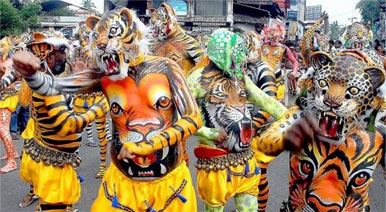
Pulikali (Tiger Dance): Hundreds of men paint their bodies like tigers and leopards, dancing to drum beats in Thrissur. It is a wild, colorful display of folk art.
-
Kathakali: Elaborate dance-dramas depicting scenes from the Mahabharata and Ramayana.
-
Vallamkali: The high-adrenaline snake boat races where 100 rowers move in perfect unison to the rhythm of ancient boat songs.
5. Modern Significance: The Onam Spirit
Today, Onam has transcended its religious roots. It is celebrated by Hindus, Muslims, and Christians alike in Kerala. It serves as a reminder that communal harmony is the true wealth of a nation.
Summary Table: Onam Essentials
| Category | Must-Know Detail |
| Traditional Attire | Kasavu Saree (White with Gold border) for women; Mundu for men. |
| Primary Decoration | Pookkalam (Intricate floral carpets). |
| The Guest of Honor | King Mahabali (affectionately called Maveli). |
| Main Dish | Onasadya (The 26-item vegetarian feast). |
| 2026 Date | Wednesday, August 26 (Thiruvonam). |
Here are the most iconic dances you will witness during Onam:
1. Pulikali: The Play of the Tigers
This is arguably the most visually striking folk art of Kerala.
-
The Performance: Hundreds of men have their bodies meticulously painted to look like tigers, leopards, and panthers. They sport "pot bellies" that they jiggle in rhythm to the thunderous beats of the Thakil, Uduku, and Chenda drums.
-
The Story: It mimics a "tiger hunt." Performers act like predators, pouncing and strutting, while others play the "hunter" trying to catch them.
-
Where to see it: The most famous Pulikali takes place in Thrissur on the fourth day of Onam.
2. Kathakali: The Classical Drama
Kathakali is the "Face of Kerala." It is one of the oldest theater forms in the world.
-
The Performance: Dancers wear massive headgears (Kireetam), heavy costumes, and elaborate facial makeup that takes hours to apply.
-
The Language: The performers do not speak; they tell stories from the Ramayana and Mahabharata using Mudras (hand gestures) and incredible facial expressions (especially the eyes).
-
Symbolism: During Onam, Kathakali plays are often performed in temple courtyards throughout the night, symbolizing the victory of good over evil.
3. Thiruvathirakali (Kaikottikali)
This is a graceful group dance performed exclusively by women.
-
The Performance: Women dressed in traditional white Kasavu sarees with gold borders form a circle around a Nilavilakku (traditional brass lamp) or a Pookkalam.
-
The Movement: They move in a circular pattern, clapping their hands in unison (Kaikottikali means "hand-clapping dance") and singing songs dedicated to Lord Shiva and Parvati.
-
Significance: It celebrates womanhood and is believed to bring long life to husbands and prosperity to families.
4. Thumbi Thullal: The Dragon-Fly Dance
This is a unique, lighthearted folk dance performed by a group of women.
-
The Ritual: A lead performer sits in the center of a circle. As the other women sing and clap around her in an increasing tempo, the lead performer enters a trance-like state, mimicking the erratic movements of a dragonfly (Thumbi).
-
Atmosphere: It is a joyous, high-spirited dance usually performed in the backyards of homes during the ten days of Onam.
5. Kummattikali: The Mask Dance
Often seen in the Malabar and Thrissur regions.
-
The Costume: Dancers wear colorful wooden masks representing various deities (like Shiva, Krishna, or Darika) and cover their entire bodies with long grass (Kummatti Pullu).
-
The Performance: They go from house to house, dancing and singing, often followed by a crowd of children. They are seen as "dispensers of blessings" from the deity to the household.
Quick Comparison: Which Dance to Watch?
| Dance Form | Energy Level | Best For | Location Tip |
| Pulikali | High / Explosive | Photography & Thrills | Swaraj Round, Thrissur |
| Thiruvathira | Low / Graceful | Understanding Tradition | Almost every Malayali home |
| Kathakali | Deep / Artistic | Culture & Mythology | Kerala Kalamandalam or Temples |
| Kummattikali | Playful / Folk | Seeing unique masks | Rural Palakkad & Thrissur |
A Knowledgeable Closing
If you visit Kerala during Onam 2026, look for the Onathallu (wrestling bouts) in the rural areas or the Thumbi Thullal (a women's folk dance). Each village has its own tiny variation of the legend, but the message remains the same: Happiness is a collective effort.